A hundred flowers bloom and reflect the ancient charm, and its brightness opens a new chapter
From February 16 to 17, 2025, Baihua Ancient Temple in Zengcheng, Guangzhou held the "First Lingnan Buddhist Culture and Art Exchange Conference and the Third Guangzhou Maritime Silk Road Buddhist Cultural Exchange Series"; through years of hard work and hard work, Baihua Ancient Temple held a celebration of completion and consecration on the morning of February 16.
Baihua Ancient Temple, formerly known as Baihua Academy, was built in 68 AD. The folk proverb says, "Before Zengcheng, there will be Baihua first", with a profound historical heritage. With the call of all sectors of society, it was approved for reconstruction in 2013. Master Yaozhi, executive vice president of the Guangdong Buddhist Association and president of the Guangzhou Buddhist Association, took on the important task of reviving the ancient temple. With the strong support of departments at all levels, Master Yaozhi led the four groups of disciples to work together. After ten years, through a series of garden ecological construction, Baihua Ancient Temple has achieved remarkable results in protecting the ecological environment, serving the public, and improving the quality of the temple, contributing to the construction of a beautiful China and promoting green development.
In the future, Baihua Ancient Temple will develop into a shining pearl of Lingnan Buddhist culture. As the "Lingnan Buddhist culture inheritance site", it explores and promotes the essence of Lingnan Buddhist culture; as the "Guangdong-Hong Kong-Macao Greater Bay Area Buddhist culture dissemination site" promotes regional cultural exchanges and integration; as the "Maritime Silk Road Buddhist cultural exchange site", it uses its geographical advantages to carry out cultural exchanges and cooperation with countries and regions along the route, helps build a community with a shared future for mankind, and contributes to the inheritance and development of Buddhist culture.
The Silk Road Buddhist Relationship: A New Era Mission to Deepen China-Thailand Buddhist Cultural Cooperation
Guangzhou has been the eastern starting port of the Maritime Silk Road for nearly two thousand years, and it is also the first stop for Buddhist coastal roads to spread the eastward spread of China. In history, countless Chinese and foreign monks and masters have spread the Dharma and preached the Dharma, translated scriptures, built temples and monks here, which has had a profound impact on the development of Lingnan Buddhism and the entire Chinese Buddhism. Their spreading deeds and translated works have become an important spiritual wealth for Guangzhou Buddhism. This kind of Buddhist cultural exchange that spans time and space has become a historical witness to the mutual learning and spiritual communication between Chinese and foreign civilizations. Since Buddhism was introduced to China, Guangzhou has not only been a "introduction platform" for Buddhist culture, but also a point of integration between Buddhist philosophy, religious art and practice. Through the two-way strategy of "bringing in" and "going out", Guangzhou has gradually built a core position of "cross-cultural exchange" and "cultural soft power", becoming a key window for Chinese Buddhist culture to go global.

In 2015, the Coast Guard Group chanted scriptures and prayed for blessings at the Buddhist Relic Pagoda of Mahajulalongkorn Buddhist University in Thailand
Promote the spirit of the Silk Road and continue writing a new chapter in the Buddhist relationship
Against the backdrop of the "Belt and Road" initiative, Buddhist culture, as an important part of the "going out" strategy of Chinese culture, demonstrates its unique role in the process of globalization by promoting transnational cultural mobility. The series of activities "Lan Kai Road - Buddhism and Culture Trip on the Maritime Silk Road" hosted by the Great Buddha Temple follows the footsteps of seeking the Dharma and monks of ancient sea roads, and relives the glorious journey of the eminent monks and great masters of the South China Sea to sacrifice themselves for the Dharma. This series of cultural exchange activities is not only a tribute to history, but also an active exploration of promoting Buddhist culture to the world in the context of the new era, becoming a "field practice" of cultural exchange. These activities convey Buddhist culture, art and its ideological system from the local area to the international stage and prompt them to "reproduction" and "reshape" them in different cultural soils.
Through interactions with the Buddhist circles of Thailand, Singapore, Malaysia, Indonesia, Sri Lanka, India, Nepal and other countries, the Great Buddha Temple has built a spiritual bridge across national boundaries and transcends language. As a cross-cultural spiritual force, Buddhism transcends the boundaries between nations and regions and becomes an important link connecting different civilizations. This activity is not only a continuation of religious exchanges, but also deeply explores the cross-domain adaptability and universality of Buddhist thought through the framework of "cross-cultural dialogue" and "transnational collaboration". The interaction between Chinese and Thai Buddhist cultures has broken through the limitations of "cultural homogeneity". Through the mutual integration of "cultural differences" and the coexistence of "heterogeneous culture", it has promoted the multi-dimensional development of Buddhist culture on a global scale.
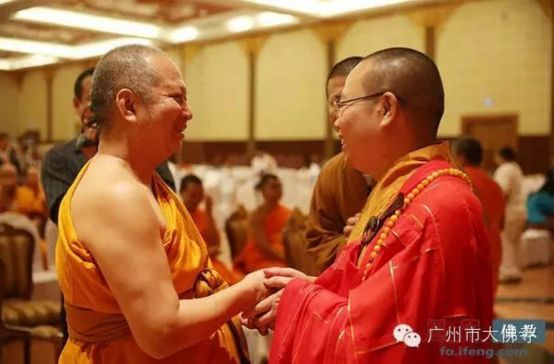
In 2015, Elder Fanzhi, President of Mahajulalongkorn Buddhist University, met with Master Yaozhi
"Deep Dharma Relationship": Promoting mutual learning between China and Thailand culture
From a historical perspective, the exchange of Buddhist culture between China and Thailand can be regarded as a typical case of "transmission of culture across time and space". In 2015, a cultural exchange group led by Master Yaozhi started a trip to Thailand, marking a new stage of development in China-Thailand Buddhist cultural cooperation. On March 5, at the Second World Buddhist Association and the Office of the Monk of Thailand held the Second World Buddhist Outstanding Leader Award ceremony at the Auditorium of the Northern University of Bangkok, Master Yaozhi and Master Benxing won the "World Buddhist Outstanding Leader Contribution Award". This is a high recognition of the contributions to the exchange of China and Thailand in Buddhism and a symbol of the deep connection between China and Thailand.
On September 23 of the same year, the Guangzhou Buddhist delegation held a Thousand Monks' Feasts at the Mahajulalongkorn Buddhist University in Thailand. 1,116 monks from 9 countries gathered together. Master Yaozhi and Elder Fanzhi, President of the Mahajulalongkorn Buddhist University, delivered speeches at the Dharma Assembly, and held in-depth discussions with the Thai Buddhist community after the Dharma Assembly, reaching a number of consensuses on exchanges and cooperation between China and Thailand, and jointly witness the solemnity and excellence of Buddhism. This is not only a religious event, but also a grand event of cross-cultural exchanges, demonstrating the inclusion and integration of Buddhism as a global culture.
In 2016, Master Yariacha from Cuba, Thailand and his party visited the Great Buddha Temple
On September 25, 2016, Master Ariacha, known as the "Maruba of Thailand", led a cultural exchange group to visit the Guangzhou Big Buddha Temple, further promoting the deepening of cultural exchanges between China and Thailand and consolidating the friendship between the Buddhist circles of the two countries. These exchanges are not only the dissemination of Buddhist thought, but also the "knowledge transfer" process of cross-cultural knowledge and beliefs. Through exchanges on platforms such as Mahajulalongkorn Buddhist University, the two sides jointly discussed the adaptability and ductility of Buddhist culture in the context of contemporary globalization.
This visit not only promoted the translation and re-creation of Buddhist classics, but also promoted the combination of "cultural inheritance" and "innovation", laying the theoretical foundation for the "transnational integration" and "cultural identity" of future Buddhist culture. By strengthening academic exchanges and cultural interactions, the Chinese and Thai Buddhist circles have gradually formed the value identity of "community culture", opening up a new path for the deep integration of cultures between the two countries.

In 2018, a delegation from Mahajulalongkorn University in Thailand visited the Ancient Temple of Great Buddha in Guangzhou
Buddha Tooth Relics: Cultural Links Symbolizing China-Thailand Friendship
On December 4, 2024, the Buddha tooth relic of Lingguang Temple in Beijing arrived in Thailand to celebrate the 72nd birthday of King Vajiralongkorn and the 50th anniversary of the establishment of diplomatic relations between China and Thailand in 2025. This solemn ceremony not only symbolizes the sacredness and solemnity of Buddhist culture, but also a historical witness to the deep friendship between the peoples of China and Thailand. During the invitation and parade in Bangkok, senior leaders, monks and people from China and Thailand participated together, demonstrating the unique role of Buddhist culture in promoting friendly relations between countries.
The worship of Buddha's tooth relics has become a landmark event in the cultural exchange between China and Thailand. This religious ceremony is not only a noble courtesy to the common belief of Buddhism between the two countries, but also demonstrates the importance of religious culture in "transnational exchanges" through "ritualization". Through this activity, Buddhist culture has not only been deeply expressed within the religious scope, but also deepens the cultural ties between the two countries through "cultural symbols" and promotes the "cross-border resonance" of cultural identity.

In 2015, Master Yaozhi delivered a speech at the Thousand Monks' Chai
Then, on January 14, 2025, the Thai Consulate General in Guangzhou held a prayer ceremony for the chanting and praying ceremony of His Majesty Maha Vajiralongkorn to achieve the same birthday as Rama I, the Bangkok Dynasty of the Kingdom of Thailand at the Great Buddha Temple in Guangzhou. The ceremony was presided over by the Great Buddha Temple Supervisory Court. Consul General Mr. Shen Yongjun, with consulate officials and spouse, attended by about 30 monks and 100 Buddhist believers. The Consulate General presented merit gold to the Great Buddha Temple to support the operation of the Great Buddha Temple’s vegetarian hall, provide vegetarian services to monks and the public, and continue to communicate in depth between China and Thailand.
Behind this incident is the multi-level practice of "cultural inheritance", which shows that Buddhist culture, as a carrier of transnational cultural exchanges, has become a "cultural capital" beyond the scope of religion and plays an important role in the diplomatic relations between China and Thailand. The worship of Buddha's tooth relics is a "significant" manifestation of "cultural symbols". It has multiple symbolic significance in the global cultural and political context and provides new impetus for the cooperation between the two countries in other cultural fields.

In 2015, Vice President Shawei accompanied the visit to the real body of Sakyamuni Buddha.
Cross-cultural common prosperity: the exchange and integration of Buddhist culture around the world
The practice of Chinese-Thailand Buddhist cultural exchanges reflects the complex interaction between global Buddhist culture in "cultural diversity" and "cultural universality". As a "transnational cultural system", Buddhism has promoted the "symbiosis and prosperity" between cultures through continuous "cultural reference" and "cultural exchange". During this process, Buddhist thought was flexibly transformed in a multicultural context, and cultural identity and community consciousness were reconstructed in the form of "global ethics".
The global spread of Buddhism relies on its core of "universal values" and promotes the two-way "identity construction" between religion and culture through cultural flow. Its core ideas of "spiritual purification" and "social harmony" not only meet the general needs of the era of globalization, but also provides spiritual support for building a "community with a shared future for mankind." The cross-cultural communication of Buddhist culture not only promotes in-depth dialogue between Eastern and Western cultures, but also provides theoretical and practical support for the development of global cultural diversity.
Create the future together: Painting a new blueprint for Buddhist cultural exchanges
Continuing the past and opening up the future, the Guangzhou Big Buddha Temple will continue to deepen Buddhist cultural exchanges with Thailand and other Maritime Silk Road countries, and promote the "global communication" and "regional integration" of Buddhist culture. From February 16 to 17, 2025, Baihua Ancient Temple in Zengcheng, Guangzhou held the first Lingnan Buddhist Cultural and Art Exchange Conference and the third Guangzhou Maritime Silk Road Buddhist Cultural Exchange Series. Just like the fate of Buddha in China and Taoism, it spans mountains and seas and connects ancient and modern times. This grand event is not only a continuation of the Buddhist tooth relics worship in Thailand, but also a new milestone in the friendship between China and Thailand. Thai monks, Mr. Palop Taili, Chairman of the World Buddhist Federation, Elder Fanzhi, Chairman of the United Nations Vessel Festival International Council, and other eminent monks and masters from home and abroad were invited to attend to discuss in-depth cooperation in the fields of Buddhist culture, art and education. This grand event not only continued the friendship between China and Thailand, but also provided an important platform for deepening "cultural diplomacy". The guests shared their experiences in the inheritance of Buddhist culture and further promoted the cooperation and co-construction of Buddhist culture under the framework of the "Belt and Road" initiative.

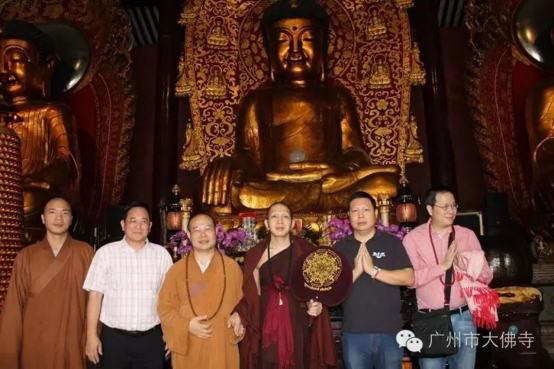
The delegation took a photo in front of the Buddha's Relic
Over the years, Buddhist cultural exchanges have been deepened, and cross-cultural interaction and academic cooperation have achieved remarkable results. As a "transnational cultural system", Buddhism not only promotes the integration of religious culture, but also provides guarantees for the sustainable development of global cultural diversity. The Buddhist Culture Association continues to serve as a bridge for global cultural exchanges, promotes dialogue and understanding of civilizations, and contributes wisdom and strength to the building of a community with a shared future for mankind. Under this great vision, Buddhist cultural exchanges not only witnessed the friendship between China and Thailand, but also played an important role in promoting world peace, promoting mutual learning between civilizations, and building a harmonious world. May the Buddha's light always shine, the Dharma friendship last forever, and the world be harmonious and symbiosis. (Text and pictures/Hundred Flowers Ancient Temple in Zengcheng, Guangzhou)